Donate
  • Events
  • Contact
  • Join Our Mailing List
  • Facebook
  • Instagram
  • LinkedIn
  • YouTube

Hilltown Land Trust

Dedicated to protecting the working lands, native habitats and rural beauty of the Hilltowns since 1986

  • About
    • Board & Committees
    • Staff and TerraCorps members
    • Affiliation with The Trustees
    • Announcements
    • Newsletters
    • Contact
    • Open Positions
  • Land Protection
    • Conservation Restrictions
    • Agricultural Preservation Restrictions
    • Financial Incentives
    • Donating or Selling Land
    • Estate Planning
    • Landowner & Town Resources
  • Properties
    • Trails & Maps
      • Big View Trail
      • Bradley
      • Breckenridge
      • Clary Hill
      • Conwell
      • Hilltown Boulders
      • Historic Dam Trail
      • Locke’s Loop Trail
      • Robert’s Meadow Brook Trail
      • Round Top Hill
      • Stevens
      • Two Mamas Farm Waterfall Trail
    • Land Stewardship
    • Conservation Stories
  • Get Involved
    • Events
    • Volunteer
    • Donate
    • Support
    • Legacy Giving
    • Gorge après Gorge
    • Vernal Pool Conservation
You are here: Home / Announcements / The Bears in Our Woods

The Bears in Our Woods

May 15, 2020

By Andrew Madden, HLT Board Member

The American Black Bear (Ursus americanus) is part of life in the Hilltowns. But it wasn’t always so. Longtime Hilltown residents might remember back to the 1960’s and 70’s when a bear sighting was still a rare occurrence. Massachusetts has been undergoing a wildlife resurgence in recent decades and bears are no exception. Black bears are generalists which makes them habitat adaptable, but they still need large tracts of undisturbed forest to live a wild existence. A survey of Hilltown residents would probably find that most are still excited by bear sightings, although they do have their detractors. For me, bears are a welcome and appreciated part of the landscape particularly when encountered while wandering our regions protected woods or swamplands.
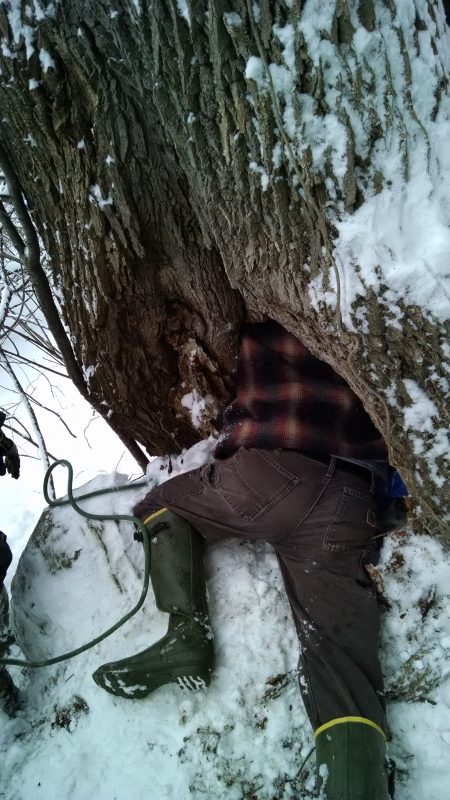
The bottom half of Andrew lying in snow, with the top half of him in a hold in a tree
As part of his work as a biologist, Andrew often visits bear dens in the winter. Here he is half-buried in one. Photo courtesy of the author.

Black bear cubs are born in the winter while the mother (or sow) is in the den. Den sites are as variable as individual bears. Some are very well constructed; under tree roots, in rock crevices, in large hollow trees, where they are dry and protected from weather. Alternatively, some bears simply create a nest and rely on snow cover for protection and warmth. Having seen a variety of dens in my role as a biologist, I have often wondered how a bear finds these locations. Do they mentally log prospective sites throughout the year while they roam, or is it a last-minute scramble for housing as winter descends? Experienced sows usually pick sites well, which is important because the cubs are active in the den, nursing and crawling as they grow.

Now that Spring is here, bears have emerged and are vacuuming up leftover food on the ground, such as acorns and carrion, until greenery becomes available. Bears can often be seen grazing in fields as grasses start to grow. (Anyone who has seen, or inadvertently stepped in, a spring bear scat can attest to the volume that comes with undigested plant material.) Spring can also be a stressful time for mothers who must produce enough milk to support 2, 3, 4 (even 5) hungry cubs.
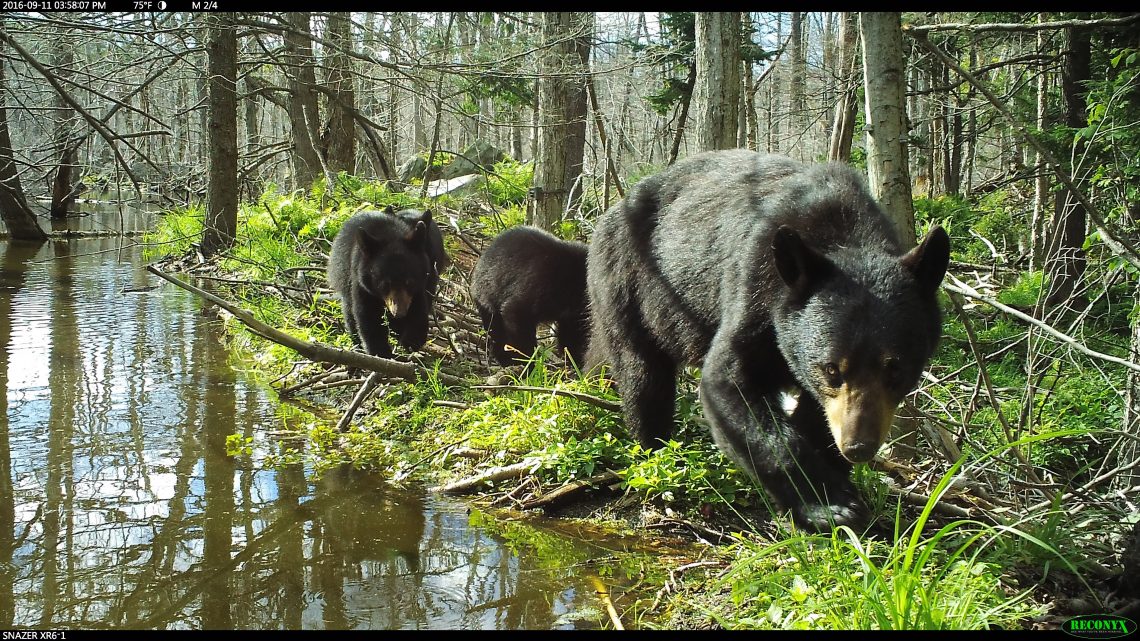
Wildlife camera photo of mother bear and three cubs walking along the edge of a pond
Bear sow and cubs. Photo courtesy of Sally Naser @crwildlifecams.

Late spring and early summer is a peak time for bear activity. Breeding season is underway, so male bears are covering great distances and females are being pursued. Yearling bears are cut loose from mom and sent on their own. As a result, the frequency of bear sightings and human encounters are greatest at this time. [On the subject of bear encounters: Black bears are incredibly powerful animals which deserve, and require, respect. However, bear behavior in the wild is generally predictable. Most bears hear (or smell) people coming well in advance and leave the area quickly. Contrary to popular belief, sows rarely defend cubs. Instead they send the cubs up the nearest tree and flee the area. If you find yourself looking up at cubs in a tree and thinking they might be abandoned, you are probably being watched carefully by the sow who is waiting just out of sight. Once the threat is over, she will call the cubs down and reclaim them. The predictability of bear behavior is compromised when bears are fed intentionally or unintentionally and the risk of an unpleasant encounter is magnified.] Note: Social distancing between bears and humans is highly recommended.

By late summer and into the fall bears, shift their concentration to weight gain. (Most adult bears are in the 150-300lb range, but males exceeding 500lbs have been documented in the Western Massachusetts.) This phase of constant eating, or hyperphagia, is more than just comfort for winter. It has direct consequences for survival and reproductive success. Although breeding occurs in the summer, the embryos don’t implant until the fall, so the success of the pregnancy depends on the body condition of the female. More weight gain equals more cubs and an increased ability to care for them. Delayed implantation is a marvelous adaptation which directly links reproduction (and species success) to healthy landscapes and diverse habitats.

Land conservation and habitat management has played a major role in the resurgence of megafauna in Massachusetts. It is easy to forget when viewing from the Hilltowns, but we do live in one of the most densely populated states in the country. We are incredibly fortunate to have open spaces where black bears can still live wild. In concert with other protected properties, the HLT lands provide movement corridors and ecological function for black bears. Without these, the pressure on large wildlife and the potential for conflict would greatly increase. The availability of HLT properties to the public offers an opportunity to see bears and bear sign. Whether you hope for an encounter or prefer to skip that particular outdoor experience, it is a good feeling to know that when you visit an HLT property you are sharing it with the fascinating black bear.

Filed Under: Announcements, Newsletter, Uncategorized

Events Calendar

Today
Sun
Mon
Tue
Wed
Thu
Fri
Sat
S
M
T
W
T
F
S
26
27
28
6:00 PM - Southern Hilltowns Land Conservation Forum
29
30
31
1
2
3
4
5
6
7
8
9
10
11
12
13
14
15
16
17
18
19
20
21
22
9:30 AM - Earth Day Trail Work at Conwell
23
24
25
26
10:00 AM - Hike at Fare-Thee-Well
27
28
29
30
1
2
6:30 PM - Vernal Pool Plunge - Webinar
3
4:00 PM - Vernal Pool Plunge - Walk
4
5
6
Southern Hilltowns Land Conservation Forum
Mar 28th, 2023    
6:00 pm - 8:30 pm
Stanton Hall
  • Workshop
What are your priorities for open space and land conservation in the beautiful Western Mass Hilltowns? Gather with friends and neighbors to share your thoughts [...]
More Info
Earth Day Trail Work at Conwell
Apr 22nd, 2023    
9:30 am - 5:00 pm
  • Hands-On
  • Work Day
Celebrate Earth Day by helping HLT extend the trail network at Conwell down to the beautiful Jackson Swamp! We will focus on building a half [...]
More Info
Hike at Fare-Thee-Well
Apr 26th, 2023    
10:00 am - 12:00 pm
Fare-Thee-Well Wholeness Center
  • Hike
Ring in spring with a hike at Fare-Thee-Well Wholeness Center in Huntington! We’ll explore a forested hillside on a moderate 1.5-mile hike, then circle up [...]
More Info
Vernal Pool Plunge - Webinar
May 2nd, 2023    
6:30 pm - 8:00 pm
  • Family Fun
  • Training
  • Webinar
Come learn about the certification process and ecology of vernal pools with naturalist and vernal pool guru, Charely Eiseman. Vernal pools are fragile ecosystems. In [...]
More Info
Vernal Pool Plunge - Walk
May 3rd, 2023    
4:00 pm - 5:30 pm
  • Family Fun
  • Hands-On
  • Hike
  • Workshop
Discover the ephemeral wonder of vernal pools with Hilltown Land Trust and naturalist Nellie Wilson! Join us for a walk in the woods where we’ll [...]
More Info
Events on Mar 28th, 2023
Southern Hilltowns Land Conservation Forum
28 Mar 23
Huntington
Events on Apr 22nd, 2023
Earth Day Trail Work at Conwell
22 Apr 23
Events on Apr 26th, 2023
Hike at Fare-Thee-Well
26 Apr 23
Huntington
Events on May 2nd, 2023
Vernal Pool Plunge - Webinar
2 May 23
Events on May 3rd, 2023
Vernal Pool Plunge - Walk
3 May 23
  • About
    • Board & Committees
    • Staff and TerraCorps members
    • Affiliation with The Trustees
    • Announcements
    • Newsletters
    • Contact
    • Open Positions
  • Land Protection
    • Conservation Restrictions
    • Agricultural Preservation Restrictions
    • Financial Incentives
    • Donating or Selling Land
    • Estate Planning
    • Landowner & Town Resources
  • Properties
    • Trails & Maps
      • Big View Trail
      • Bradley
      • Breckenridge
      • Clary Hill
      • Conwell
      • Hilltown Boulders
      • Historic Dam Trail
      • Locke’s Loop Trail
      • Robert’s Meadow Brook Trail
      • Round Top Hill
      • Stevens
      • Two Mamas Farm Waterfall Trail
    • Land Stewardship
    • Conservation Stories
  • Get Involved
    • Events
    • Volunteer
    • Donate
    • Support
    • Legacy Giving
    • Gorge après Gorge
    • Vernal Pool Conservation

Learn

  • Announcements
  • Staff and TerraCorps members
  • Contact

Participate

  • Events
  • Volunteer
  • Donate
  • Subscribe

Hike

  • Bradley
  • Breckenridge
  • Stevens
Land Trust Accreditation seal
Contact Us
admin: Log in
© 2026 Hilltown Land Trust | Hilltown Land is a 501c3 nonprofit organization | Est. 1986